Return to Home Return to Overview Mechanical Reference
Decima Recommended Strategy
Table of Contents
This strategy, also known as the “Turnaround” strategy, is the most common way of playing Decima CM. It was originally designed for achievement runs, minimizing movement and difficulty while satisfying all mechanics in a deterministic manner.
All markers referenced in this guide can be set up with the Commander Markers module for Blish HUD, using the marker pack provided below.
Click to view markers
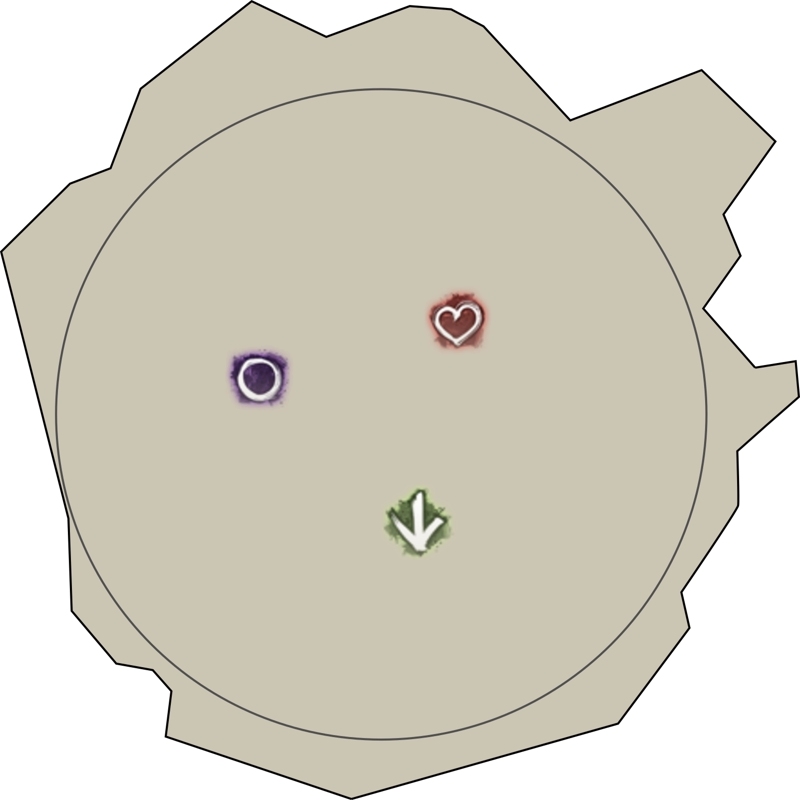
Paste the following code into Commander Markers to use this marker pack:
eyJlbmFibGVkIjp0cnVlLCJuYW1lIjoiRGVjaW1hIENNIFN0cmF0ZWd5IiwiZGVzY3JpcHRpb24iOiJEZWNpbWEgQ00gc3RyYXRlZ3kgbWFya2VycyBwYWNrIGJ5IE1pa2UgW0NSU10iLCJtYXBJZCI6MTU2NCwidHJpZ2dlciI6eyJ4IjotMjc2LjU1NjEyMiwieSI6MjY1Ljc3OTU3MiwieiI6MTM4LjUxNjc2OX0sIm1hcmtlcnMiOlt7ImkiOjEsImQiOiJTb3V0aCBtYXJrZXIiLCJ4IjotMjU2Ljk5MDEsInkiOjMxNi40OTY0NiwieiI6MTM4LjUyMjM1NH0seyJpIjoyLCJkIjoiV2VzdCBtYXJrZXIiLCJ4IjotMjc3LjA4MzI4MiwieSI6MzM5LjE4OTk0MSwieiI6MTM4LjUyMjM1NH0seyJpIjozLCJkIjoiTm9ydGggbWFya2VyIiwieCI6LTI0OC41NDI3NCwieSI6MzQ3LjI0NDE0MSwieiI6MTM4LjUyMjM1NH0seyJpIjo3LCJkIjoiUm9sbCBvdXQgc3BvdCEgKHN0YXJ0aW5nIGxvY2F0aW9uKSIsIngiOi0yODIuNDU2MiwieSI6MjczLjQ2MDksInoiOjEzOC41MTY1fV19
This is an in-depth guide: if you are looking for something fast to read and less comprehensive, check out the Decima Fast Guides.
Main Points
- The squad divides into a ranged group and a melee group.
- The ranged group stays far from the boss to bait Fluxlances.
- The melee group stays close to the boss to bait Thunder and collect Greens.
- One player covers a special role, the kiter, and controls spawn positions for several important mechanics.
- The position of the two different groups and the kiter are carefully controlled to minimize overlap between mechanics.
General Information
Decima’s encounter is inherently deterministic, giving the squad a large amount of control through careful positioning.
Melee and Ranged Group
Many of the more dangerous mechanics in the encounter choose their targets based on proximity to the boss:
- Fluxlances always target the furthest players.
- Thunders always target the closest players.
Furthermore, the effects applied by some mechanics prevent affected players from participating in others:
- Players hit by Fluxlances will be affected by
Galvanic Sensitivity, and thus cannot collect Greens.
- Players staying within Thrumming Presence will be affected by
Harmonic Sensitivity, making them more vulnerable to Fluxlances.
This strategy solves this issue by separating the squad into a ranged and a melee subgroup.
- The ranged group is responsible for baiting Fluxlances by being the furthest players from the boss, and pointing them away from Conduits.
- The melee group is responsible for baiting Thunder by being the closest players to the boss, and collecting Greens.
In this way, most strategies eliminate harmful overlaps and reduce the overall stress on each player while retaining deterministic control of all mechanics.
Kiting
Several of Decima’s mechanics focus around the furthest player from the boss:
- Harmonious Thunder charges Conduits closest to them.
- The Red Fluxlance will target them.
- The Focused Fluxlance will target the conduit furthest from them.
We can take advantage of this by implementing a specific role, the kiter. This player can exercise a great amount of control over the encounter through accurate positioning:
- During Chorus of Thunder, they can choose which Conduits are charged by staying close to them.
- While satisfying the previous point, they will also bait out the Red Fluxlance.
- While satisfying the first point, they can also ensure that the Focused Fluxlance spawns in an advantageous position.
Kiters often have to move off-stack to do mechanics: this makes for lower DPS uptime and higher survivability requirements. For this reason, kiters are often the healers for the ranged subgroup.
Composition
Support players should be providing good defensive boon coverage and healing. Decima has many strong bursts of damage incoming from various mechanics (Fluxlances, Seismic Crash, Flux Nova), so drops in Protection and insufficient healing can quickly lead to players downing.
Stability or
Aegis are required at regular intervals, portals are very useful to simplify the split phases (especially for the melee group) and good burst CC is necessary to break Decima’s massive
Defiance Bar. Due to these requirements,
Mesmers such as
Chronomancer and
Troubadour are by far the most played healers, though not the only viable ones. Kiters will also greatly benefit from mobility and boon radius, as their subgroup will often have to spread out to do mechanics.
While there are less strict requirements on the boonDPS and DPS than on the healers, the ranged group will spend a decent amount of time out of melee range and thus it is recommended to use appropriate builds. DPS in general should also try to bring sufficient amounts of CC, and boonDPS should bring backup Stability if possible.
Builds and PoVs
This is a non-exhaustive list of playable builds on the encounter. If anything is outdated, you can find up-to-date information on Void Lounge.
| Build | Role | PoV | Last updated |
|---|---|---|---|
| Heal, Kiter | PoV (Kiter) PoV (Melee) | September 2025 | |
| Heal, Kiter | PoV (Kiter) PoV (Melee) | August 2026 | |
| Heal, Kiter | PoV (Kiter) | April 2025 | |
| Heal, Kiter | PoV (Kiter) | September 2025 | |
| Heal, Kiter | PoV (Kiter) | July 2025 | |
| Ranged BoonDPS | September 2025 | ||
| Ranged BoonDPS | PoV | May 2025 | |
| Ranged DPS | June 2025 | ||
| Ranged DPS | PoV | June 2025 | |
| Melee DPS | PoV | August 2025 |
First Phase
100% - 80%
The fight begins by making use of Mount abilities to quickly enter the arena and reach Decima, usually either  Roll Out or
  Leap.
Leap.
Decima starts with the attack pattern shown here. The Foreshock & Mainshock abilities are simply out-healed.
At the start of the Mainshock ("pizza" attack) cast, the ranged group needs to step away from the boss to the marker to bait Fluxlances. Once they have baited them, spread out to avoid overlaps and charging pylons.
The kiter should instead go to roughly the marker (see image below) in order to bait Thunder into charging up the conduits directly behind the melee group.
Try not to charge up any of the conduits that make up the outer ring furthest from Decima. These will encircle the boss in the following phase, making collecting their Greens much more difficult (see this animation).
Shortly after the Fluxlances will fire. Make sure to not hit any conduits and then quickly group up on the marker and heal up and give
Stability or
Aegis to prevent the
knockback from Seismic Crash.
It is always better to provide Aegis over
Stability for Seismic Crash, as the damage done by this skill is noticeable, especially for the melee group.
Immediately after, the ranged group will bait the next set of Fluxlances, while the melee group collects Greens. This set of Fluxlances contains the Red Fluxlance, so make sure the kiter should ensure they are the furthest player from boss. They can then use a mobility skill to get behind a conduit and survive the mechanic.
After the collection and Fluxlances, the attack pattern starts from the beginning again, with Foreshock & Mainshock. Again, once the pizza attack starts, the ranged group needs to bait arrows. The kiter needs to pay attention here and make sure they are at the marker to bait Thunder.
Depending on the group’s DPS, you may already phase now into the first split phase; if not, you will get another Knockback. Ideally it would be better to phase before or during the next set of greens, so as to avoid an additional collection.
Phasing after the second collection usually indicates a DPS issue: this needs to be resolved or the group will struggle greatly with the damage check in the final phase.
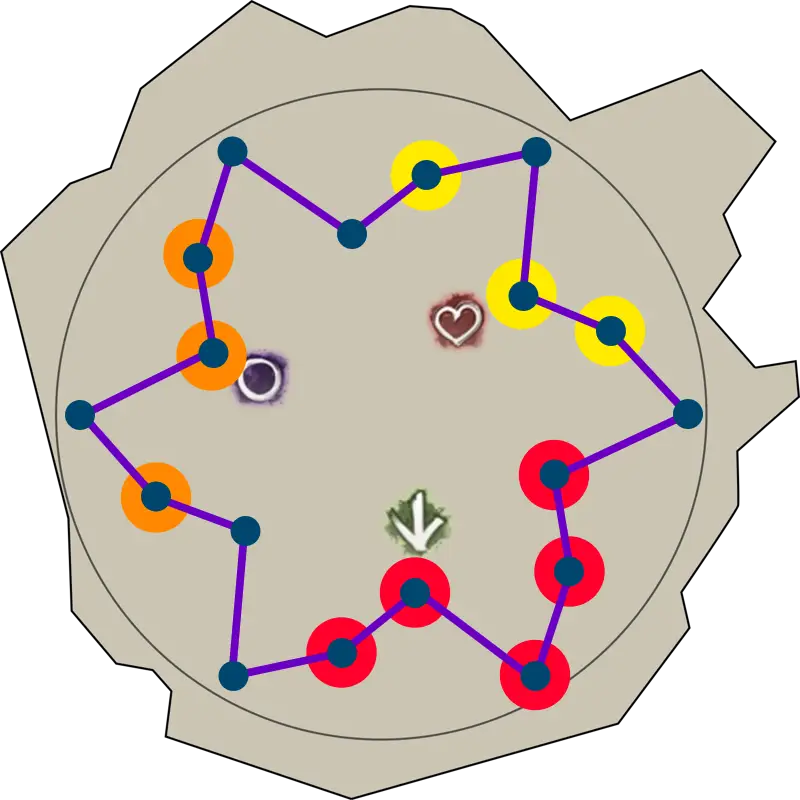
The kiter’s positioning in this phase is meant to spread out the charged Conduits between the inner rings of the formation. In this way there will be less Greens in the next phase. When played correctly, only one of the outer conduits should be charged. In the image below for example, the red conduits will have been charged during the first set of arrows, the orange during the second, and the yellow during the third.
First Split Phase
The ranged and melee group will split to their respective closest Transcendent Boulder, on for the ranged group and
for the melee group. This is usually directly behind the groups’ current position, meaning they can usually turn around 180° and walk to their split phase position (this maneuver is the origin of the name “Turnaround Strategy”).
The two healers should prepare their portal next to Decima before going to the adds. The ranged group’s can be prepared outside the cage, while the melee group’s should be inside the cage.
Experienced squads will portal both subgroups into Decima’s cage. This is usually a small DPS increase for the ranged group, but requires more careful positioning.
The melee portal should be prepared to the right of Decima, not in front. This prevents melee players from getting hit by by Fluxlances after taking the portal.
While damaging the Transcendent Boulder adds down as fast as possible, it’s important to not use any skills with defiance damage in order to skip their dangerous follow-up attacks.
Decima will continue her attack loop from where she left off after jumping, resulting in a set of Fluxlances and Thunders that must be played, while within the smaller arenas. The ranged group should position themselves on the far side of the Transcendent Boulder from Decima; the melee group on the closest side, in order to bait the mechanics properly. The melee group can simply dodge their Thunders, while the ranged group needs to pay attention to not charge any extra conduits.
After the Fluxlances and Thunders, the two healers can open their portals to get everyone back to the main boss.
80% - 70%
Decima will normally use Seismic Crash shortly after both groups take the portals, so healers should make sure to immediately provide Stability or
. The attack pattern for the rest of the phase is the same; next will be a set of Fluxlances (usually with the Red Fluxlance included) and a Green collection. Play the mechanics as before, heal everyone up and prepare your CC skills for when Decima hits 70%.
At 70% HP, Decima will become immune to damage and jump into the middle of the arena. This is a knockback attack, so make sure to provide Stability again. Depending on DPS, Thunders might also spawn, be prepared to dodge them, while also paying attention to not charge any conduits.
Decima will then gain a Defiance Bar with 7500 HP. This needs to be broken as soon as possible, as otherwise the group will need to deal with an additional Green collection. Once it is broken, make sure that both groups are stacked up for Flux Nova. Pre-cast
Protection and barrier, then time your strong healing skills with the burst to prevent any
Downstates.
Second Phase
70% - 50%
In this phase Decima repeats her attack pattern starting from Foreshock & Mainshock. The melee group can stand near the marker. The ranged group can wait until the pizza attack to move to
marker to bait Fluxlances. The kiter should try to remain behind the melee group to charge conduits.
Once these mechanics are complete, stack up quickly to heal and provide Stability or
Aegis for Seismic Crash. The melee group will then collect any Greens, while the ranged group baits the next set of Fluxlances. The kiter should take care to bait the Red Fluxlance and move behind a conduit.
Decima will then restart her attack pattern. The ranged group can rotate slightly to follow the pylon formation, while the melee group should continue standing near . You should ideally be phasing before or during the next collection, as in phase 1.
Second Split Phase
Similar to the previous split phase, both groups go to their closest Transcendent Boulder while the healers prepare their portals. Usually, the melee group will go towards the marker and the ranged group towards the
marker. The split phase plays similar to before, only it is much more important to not break the add’s
Defiance Bar, so as to avoid Sparkwave, which will usually wipe the group.
Do not CC the Transcendent Boulder! A huge number of wipes happen in this phase due to early CC leading to Sparkwave casts. If you do CC early, the healer in your cage should try to be the furthest from the add, and bait the attack away from the other subgroup’s cage. Everyone else should move opposite to them, so that they are not hit.
As before, the ranged group positions themselves outward to bait Fluxlances and melee group inward to bait Thunders. The ranged group needs to pay attention again to not hit any conduits with Fluxlances and the melee group needs to time their dodge again. As soon as both adds are dead and the two mechanics are done, use portals once more to quickly get back to Decima.
50% - 40%
This section plays identically to the 80% - 70% section. After taking the portal, be ready to give Stability or
Aegis to prevent knockbacks. The melee group will be inside the cage collecting Greens; the ranged group will be baiting Fluxlances. Once Decima hits 40%, be ready to dodge Thunder while not charging any conduits. CC, stack up and heal through the Flux Nova once more.
Third Phase
40% - 10%
Decima will begin this phase by jumping toward the edge of the arena. The jump is a Seismic Crash that inflicts knockback, so provide
Stability or
Aegis.
The melee group will then position to Decima’s side; the ranged group will stay in the middle, stacking between the two conduit formations. Decima will being her attack pattern as usual: Fluxlances will spawn shortly after the “pizza” attack.
The kiter in this phase has the additional responsibility of managing the spawn position of the Focused Fluxlance (aka Green Arrow). To do this, they should move to the conduits on the opposite side from the melee group. This will charge those conduits and force the Focused Fluxlance to spawn on top of the melee group.
The melee group must stack inside of the Focused Fluxlance to solve the mechanic. This can overlap with Thunders: in this case they will need to dodge backwards while still staying inside the Green Arrow. Alternatively, if you are running a Troubadour, they can time
Tale of the August Queen to nullify the spreads.
Decima will then Seismic Reposition to a different position. Be ready to provide Stability or
Aegis and follow her to her new location. The melee group can position themselves to stand between Decima and the conduits that have been charged up already; this is usually the opposite side from where they were stacking previously. The ranged group should will remain in the center.
Decima will once more cast Foreshock & Mainshock after jumping. Once the “pizza” attack appears, the kiter should be ready to bait the Red Fluxlance. To deal with Converging Fluxlances, they should position accurately as shown in the image below. This blocks the Red Fluxlance while preventing any conduits from getting charged by the normal Fluxlances.
Decima’s attack pattern will then recommence from scratch. After the next pizza, the kiter will again need to bait the Focused Fluxlance by standing on the opposite side from the melee group.
Next, Decima will jump again, and will cast Foreshock & Mainshock followed by a collection. The melee group this time must split between the left and right in order to collect all greens: their healer should take care to keep all the players healthy even while they are off-stack.
This sequence of attacks repeats continuously until Decima is lowered to 10% HP, upon which she transitions into the final phase.
Final Phase
10% - 0%
Cleanly transitioning into this phase is extremely important due to the relatively tight DPS-check: any downs or knockbacks at this stage may seriously affect the likelihood of a kill. Depending on the DPS spec, it might also be beneficial to save some cooldowns for the initial burst (e.g. Weave Self).
At the start of the phase, Decima will become Invulnerable and jump into the center of the arena, resetting all conduits. The jump is a knockback, so have
Stability or
Aegis up. At the same time Decima will cast any remaining Thunders, be ready to dodge. Depending on DPS, you may have two subsequent Thunder casts: be prepared to dodge twice.
This combination of Seismic Crash and Thunder is extremely lethal: players should always attempt to dodge both components (called “double dodging”).
Soon after this, a final set of Fluxlances and Thunders must be played. The kiter should bait the Red Fluxlance and position behind a conduit to survive.
Afterwards, stack up at the boss and DPS. Thunders will spawn continuously throughout this phase. The first targeted players should spread out: this increases DPS by not requiring dodges. Once everyone starts getting a spread, dodge them forwards into the boss’ hitbox: dodging backward or sideways may hit and charge multiple conduits, as they slowly start coming closer as the phase progresses.
Greens will start spawning as well, gradually escalating from only a few greens to massive simultaneous 18-conduit discharges. Try to block them as well as you can, while focusing on DPS and dodging Thunders.
If 10 Greens move into Decima’s hitbox, Decima will become invulnerable and you will wipe. It is important to block as many as possible and kill quickly before the situation escalates. Doing this successfully, keeping up damage, and avoiding downs will lead you to a successful clear.